
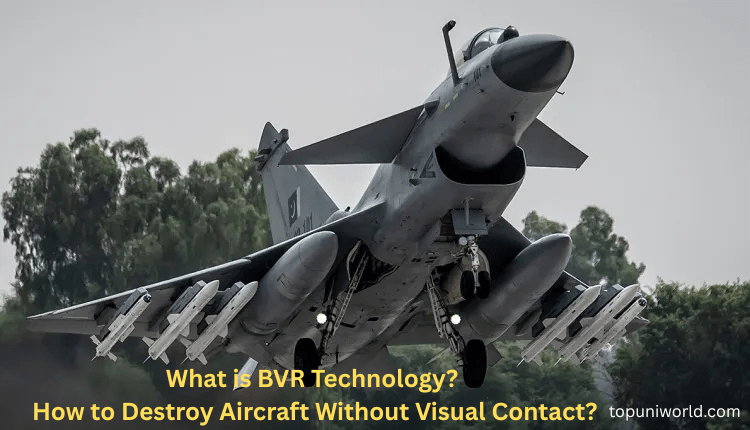
BVR: What is the Technology to kill the aircraft without seeing it?
On February 27, 2019, when the Pakistan Air Force carried out an attack near an army camp in Indian-administered Kashmir under Operation Swift Retort and claimed that the operation was carried out within Pakistani airspace, many were surprised.
The first question is how was this possible? The pilot did not cross the border or look at the target, so how did the missile hit the target?
It was at this moment that the public and experts first started to learn about the practical use of ‘BVR’ i.e. Beyond Visual Range technology. Similarly, on the intervening night of May 6 and 7, 2025, when the Pakistan Air Force claimed that it had destroyed five Indian Air Force aircraft in Indian airspace, many people were shocked by this claim. To target without seeing with eyes in the boundaries of the enemy country at such a distance. Is it really possible or is it just a claim?
In fact, today’s war is not limited to traditional methods. This is the era when a pilot does not even need to see or get close to an enemy aircraft.
With the press of a button with modern technology, an aircraft standing hundreds of kilometers away can also be targeted, even if it is standing at its airbase. This technology is called ‘BVR’ – a silent, but deadly weapon.
BVR: The ability to hit the aircraft without seeing it
BVR missile means a weapon that targets enemy aircraft far beyond the visual limit. These missiles rely on radar, data link and artificial intelligence, and modern air warfare is decided by them.
Pakistan currently has a Chinese-made PL-15 missile, which is currently one of the most advanced BVR missiles in the world. It has been installed on advanced aircraft such as JF-17 Block 3 and J-10C.
Air defense expert Rafiq Dogar says, “This is not just a missile, but a thought in which the enemy is not even aware and his plane has fallen.” The real power is what is not visible. ‘
The PL-15 has a range of more than 200 kilometers. It constantly collects data from the host aircraft during the flight and finds and targets the target itself at the last moment. That is, the missile itself decides from which angle and at what time to strike … without any human intervention.
When did Pakistan reach this technology?
Pakistan took the first step towards BVR technology two decades ago through the development of JF-17 Thunder in collaboration with China. Early versions included the SD-10 missile, a medium-range BVR missile. It was an early but important step that laid the foundation for Pakistan’s concept of modern air warfare.
Later, when India acquired the French Meteor missiles along with the Rafale aircraft, Pakistan also improved the competition in many ways by acquiring the PL-15 missile with Chinese support.
The PL-15 includes advanced features such as AESA radar, data link, and ECCM that protect it from enemy radar, jamming, and other electronic attacks. By firing it from platforms like JF-17 Block 3 and J-10C, Pakistan has revolutionized its air capabilities.
According to Commodore (retd) Shahzad Ali, “It is not just a question of weapons but a matter of strategic strategy. The pl-15’s presence has changed the rules of air warfare. Pakistan has given a message that if war is imposed, even Indian airbases will not be safe. ‘
Along with this development, Pakistan has also developed in defense complexes, aeronautical complexes and digital warfare systems at the local level. It is not just a defensive capability, but a ‘deterrence’ i.e. the force to stop the enemy before attacking.
What does India have?
India also has some BVR missiles, such as the Russian R-77 and the French Meteor. But according to experts, due to the combination of Russian, French and Israeli technologies in the Indian Air Force systems, there are many problems in data linking, compatibility of sensors and response speed.
Pakistan has an integrated, cohesive and reliable system that gives its air force the ability to take timely decisions and take action. This is the superiority that can prove decisive on the battlefield.


















 Online Education
Leave a comment